Obi Promises First-Year Impact, Functional Primary Healthcare In 8,809 Wards
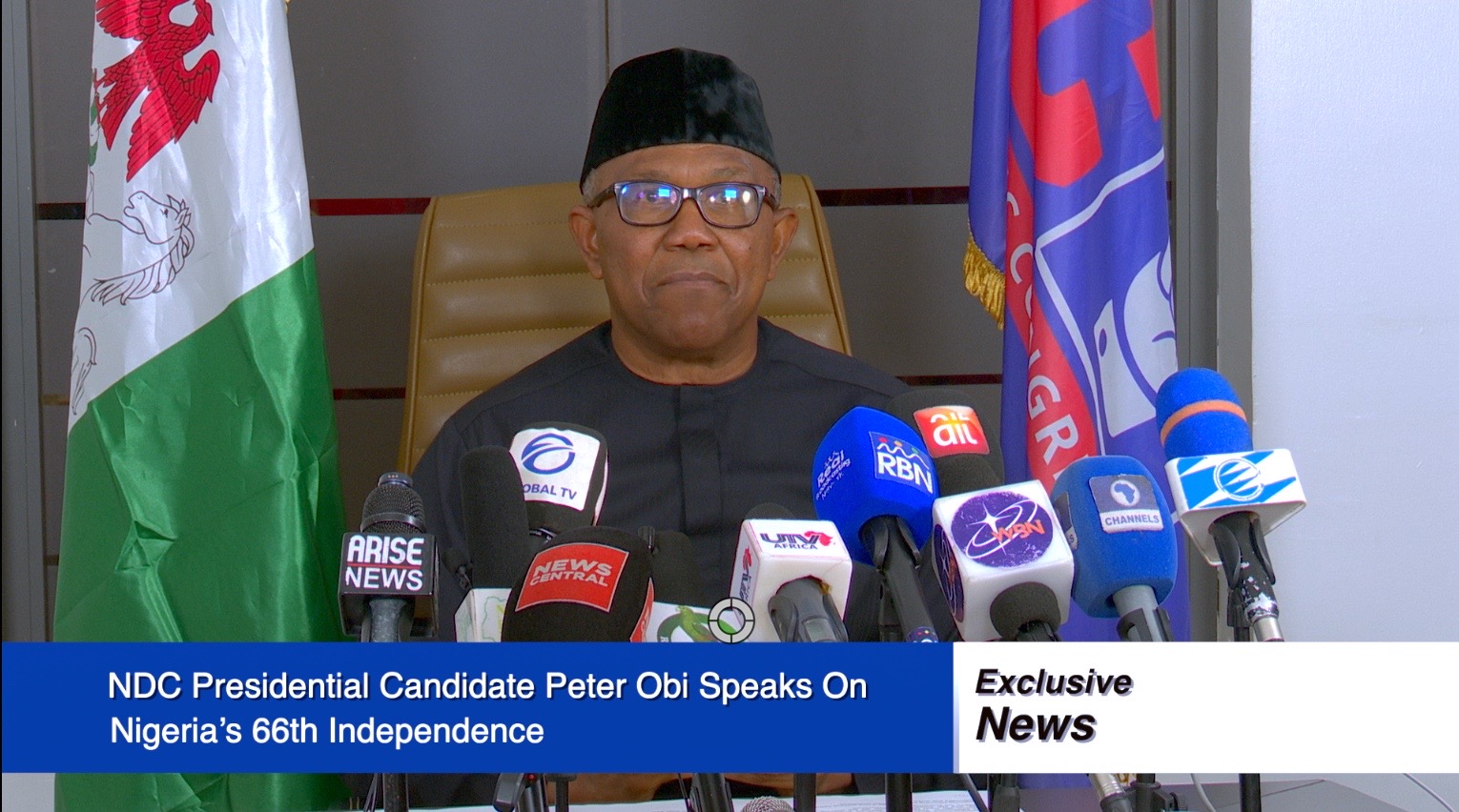
Presidential candidate of the Nigeria Democratic Congress, NDC, Peter Obi, has promised Nigerians tangible improvements in their lives within his first year in office if elected President, pledging to establish functional primary healthcare services across the country’s 8,809 wards.
Obi made the commitment in his Independence Day broadcast to mark Nigeria’s 66th anniversary, in which he outlined his vision for tackling insecurity, poverty, unemployment, hunger and the country’s declining social welfare indicators.
The former Anambra State governor said his administration would make governance measurable, accountable and focused on the welfare of citizens and national productivity.
According to him, Nigerians should begin to experience the impact of purposeful leadership within the first 12 months of his presidency.
Obi identified security, education, healthcare and productive enterprise as priorities, insisting that these are fundamental requirements for a functioning economy rather than luxuries.
On healthcare, the NDC presidential candidate pledged to ensure functional primary healthcare centres in all 8,809 wards, noting that the country should ideally have about 10,000 functional primary healthcare facilities.
He said no mother should die because she cannot access medical care, just as no child should be denied education because of poverty or insecurity.
Obi also promised to tackle insecurity decisively to enable farmers to return to their farms, children to resume schooling, businesses to operate freely and families to live without fear.
He declared that no Nigerian should be forced to live in an internally displaced persons’ camp, adding that those currently displaced must be supported to return to their communities.
The NDC presidential candidate expressed concern over the conditions of internally displaced persons in Ramin Kura, within the Sokoto metropolis, which he visited alongside Senator Rabiu Musa Kwankwaso after a two-day engagement with residents of Sokoto State.
Obi said the visit exposed the difficult conditions facing thousands of women and children displaced from their homes, with many children lacking access to education and families struggling to obtain basic healthcare and other necessities.
He described their situation as a reflection of the hardship experienced in several parts of the country, arguing that Nigerians should be living securely in their communities, pursuing education, farming and conducting businesses rather than surviving in displacement camps.
The NDC presidential candidate blamed the country’s leadership for failing to adequately address the challenges confronting Nigerians, particularly children and young people.
He cited poverty, out-of-school children, youth unemployment, hunger, drug abuse and insecurity among the problems requiring urgent national attention.
Obi maintained that Nigeria’s major challenge was not a lack of resources but the failure to translate its abundant human and natural resources into human development, productivity, security and shared prosperity.
He therefore called for a shift from a consumption-driven economy to one focused on production, job creation, agriculture, manufacturing and investment in human capital.
The former Anambra governor said his administration would prioritise opportunities for young people to work, prosper and build meaningful lives in the country.
Obi also pledged to lead by example, declaring that he would spend his holidays within Nigeria throughout his four-year presidential tenure.
He said such holidays, including working holidays, would take him to states such as Zamfara, Borno, Gombe, Ebonyi and Ekiti, among others, to enable him to understand the challenges facing different communities, listen to citizens and appreciate their resilience.
Reflecting on Nigeria’s 66 years of independence, Obi said the anniversary should be an occasion for sober reflection rather than celebration alone.
He urged Nigerians to examine the country’s current condition, assess its progress and determine whether it was moving in the direction envisioned by its founding fathers.
The NDC presidential candidate argued that the country’s challenges demanded honest national reflection and responsible leadership, rather than a belief that Nigeria’s difficulties were inevitable.
Despite the challenges, he expressed optimism about the country’s future, declaring that a new Nigeria was possible through responsible governance, accountability and the effective deployment of public resources for the common good.
Obi said his vision was to build a secure, united and productive country governed with competence, peace and justice.
He called for a Nigeria where farmers could safely cultivate their land, young people could find employment, children could access education and citizens could obtain essential healthcare without being denied services by poverty or insecurity.
The NDC presidential candidate concluded his Independence Day message with a call for Nigerians to look back with gratitude, assess the present honestly and approach the future with renewed determination.
He maintained that the Nigeria citizens desire must be built through collective responsibility and purposeful action, not prayers and political promises alone.
Obi expressed confidence that the country could achieve the transformation Nigerians seek, assuring citizens that a new Nigeria was possible.
By James Ezema