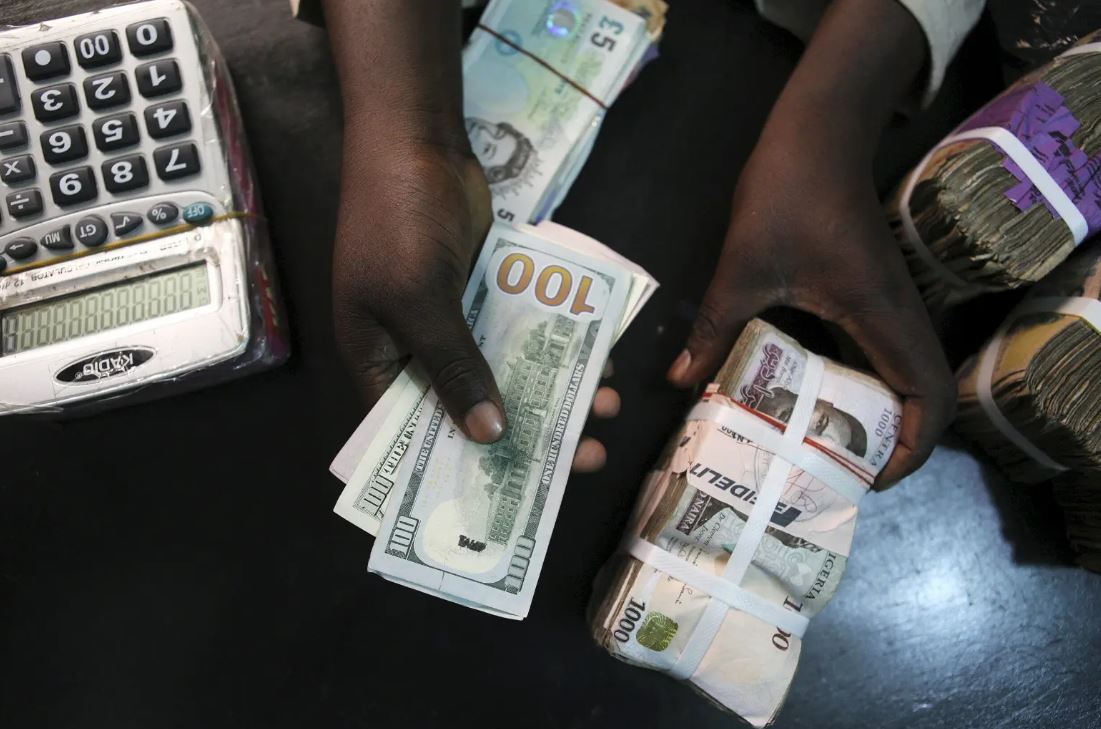
Nigeria’s Net Forex Inflow Drops 18.3% to $48.1bn in Nine Months
Net foreign exchange inflow into Nigeria declined by 18.3 per cent year-on-year to $48.1 billion in the nine months ended September 2025, down from $58.8 billion recorded in the same period of 2024, reflecting weaker external earnings and reduced capital inflows.The contraction was largely driven by a sharper 15 per cent decline in foreign exchange inflows, which outweighed a 12.2 per cent reduction in forex outflows during the period.
Data from the Central Bank of Nigeria (CBN) on foreign exchange flows for the third quarter of 2025 showed that total forex inflows fell to $83.71 billion in the nine-month period, compared with $99.44 billion a year earlier. Over the same period, forex outflows declined to $35.65 billion from $40.61 billion in 2024.
A closer look at the inflow composition revealed a significant drop in forex inflows through the CBN, which fell by 30 per cent year-on-year to $28.72 billion in 9M’25, from $40.15 billion in the corresponding period of 2024. Inflows through autonomous sources also declined, though at a slower pace of 6.8 per cent, to $54.99 billion from $59.29 billion.
On the outflow side, forex outflows through the CBN decreased by 18.8 per cent year-on-year to $25.68 billion, compared with $32.16 billion in the previous year. In contrast, outflows through autonomous sources increased by 18 per cent to $9.97 billion, up from $8.44 billion in 9M’24.
As a result, net forex flow through the CBN fell sharply by 62 per cent year-on-year to $3.04 billion, from $7.99 billion in the same period of 2024. Net flows through autonomous sources also weakened, declining by 11.5 per cent to $45.02 billion from $50.85 billion.Further analysis showed that inflows from International Money Transfer Operators (IMTOs), a key component of autonomous forex supply, weakened across all three quarters of 2025, highlighting pressures on diaspora remittances.
In the first quarter, IMTO inflows declined by 18 per cent year-on-year to $888.3 million from $1.08 billion in Q1’24. The second quarter recorded a 6.5 per cent decline to $1.18 billion, compared with $1.26 billion a year earlier. In the third quarter, inflows fell more sharply by 22 per cent to $1.15 billion from $1.48 billion in Q3’24.
The sustained weakness in IMTO inflows contributed to the moderation in autonomous forex supply, despite policy efforts aimed at attracting diaspora remittances through formal channels.
Quarterly trends showed that net forex inflow declined by 6.4 per cent quarter-on-quarter in Q1’25 and by 4.1 per cent in Q2’25. However, the trend reversed in the third quarter, with net forex inflow rising by 20 per cent quarter-on-quarter.
According to the CBN’s Q3’25 Quarterly Economic Report, the improvement was driven mainly by a sharp reduction in forex outflows through the Bank. Net forex inflow increased to $17.46 billion in Q3’25, up from $14.46 billion in the preceding quarter.
During the quarter, aggregate forex inflow dipped slightly by 4.17 per cent to $26.27 billion from $27.41 billion in Q2’25, while forex outflow fell sharply by 32.01 per cent to $8.80 billion from $12.94 billion, providing modest relief to the external position.
#UTVAfrica#