NHRC, UN Advocate for Ethical, Hate-Free Politics in Nigeria
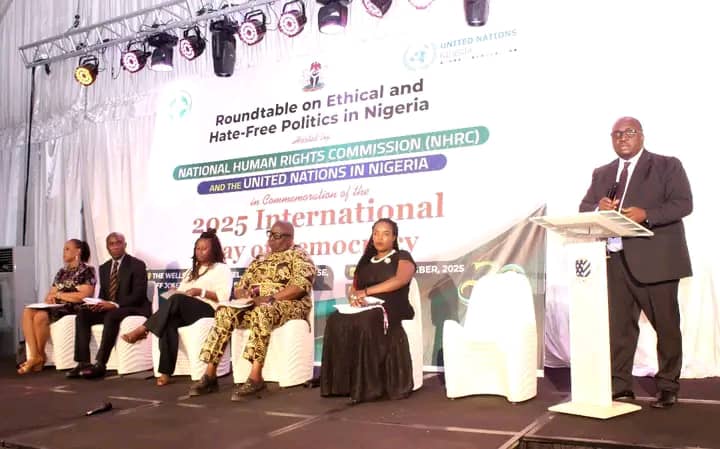
The National Human Rights Commission (NHRC) and the United Nations Resident Coordinator in Nigeria have called for the promotion of ethical and hate-free political practices across the country. This appeal was made during a roundtable event held in Abuja to commemorate the 2025 International Day for Democracy.
The global theme for this year’s celebration, “Achieving Gender Equality, Action by Action,” emphasized the critical role of gender equality, citizen participation, and strong democratic institutions. The roundtable discussion, themed “Hate Speech, Human Rights and Elections in Nigeria’s Politics: Trends and Impacts,” brought together political leaders, civil society organizations, media professionals, and human rights advocates to examine the negative effects of hate speech and unethical political behaviors on Nigeria’s democratic processes.
Speaking at the event, NHRC Executive Secretary, Dr. Tony Ojukwu, SAN, stressed that hate speech is deeply intertwined with human rights.
“To those spreading hate speech, it is seen as an expression of free speech and opinion. But to the victims, it represents a violation of their dignity and right to be free from discrimination — whether religious, political, ethnic, gender-based, or cultural,” he stated.
Dr. Ojukwu highlighted that democracy must be upheld not only through elections but also through the values practiced between electoral cycles. He condemned vote-buying, hate speech, and voter intimidation, describing them as violations of democratic principles that discourage public participation and erode trust in the system.
He also announced that the NHRC, in collaboration with the United Nations and other stakeholders, is drafting a Charter on Ethical and Hate-Free Politics. The goal is to secure the commitment of political parties to peaceful, inclusive, and human rights-focused campaigns.
“As we celebrate this Day for Democracy, we must recommit to building a Nigeria where all citizens can engage safely, freely, and meaningfully in the political process,” Ojukwu urged.
UN Resident and Humanitarian Coordinator in Nigeria, Mr. Mohamed Fall, also spoke at the event, warning about the rapid spread of hate speech in the digital era. He cited the UN Secretary-General’s concerns about how online hate and misinformation can enter mainstream discourse, sowing fear and fueling violence.
“Digital platforms, when misused, can erode trust in democratic institutions and endanger human rights,” Fall said.
He emphasized the importance of information integrity — ensuring that public discourse is based on accurate, reliable, and consistent information. According to Fall, unchecked disinformation, particularly during elections, misleads citizens and undermines democratic decisions.
“In Nigeria, political engagement should be a source of unity and national pride, not division. We have seen globally how hate speech can trigger violence — and even genocide,” he cautioned.
INEC Chairman, Prof. Mahmood Yakubu, also lent his voice in support of the initiative. He described the roundtable as vital to the electoral process, praising it as a platform that fosters dialogue, mutual understanding, and civility in political competition.
“Such discussions help reduce political tension, promote respect for electoral laws, and ease the work of electoral bodies like INEC,” Yakubu noted.
He expressed gratitude to all participants for their commitment to strengthening democratic values, adding that INEC looks forward to continued collaboration to ensure that Nigeria’s electoral process remains peaceful, credible, and inclusive.
(Source: NAN
#UTVAfrica#