Wits University Supports Record-Breaking Electric Vehicle Expedition Across Africa
The Mobility and Electrification Research for Africa (MERA) Lab at Wits University has played a significant role in supporting an ambitious electric vehicle expedition aimed at setting a new world record for visiting the highest number of countries in a fully electric vehicle.
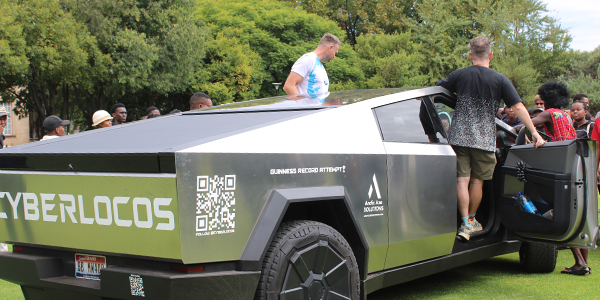
The international expedition, known as CyberLocos, was hosted by the MERA Lab during the South African leg of its journey. Led by Professor Lesedi Masisi and Dr Muhammed Aswat, the research team provided technical expertise and logistical support to help the expedition continue its mission across the continent.
The CyberLocos team is travelling across multiple continents in a Tesla Cybertruck, using the journey to demonstrate the viability of long-distance electric vehicle travel while highlighting the opportunities and challenges of electric mobility in regions where charging infrastructure remains limited.
During the visit to Wits University, the MERA Lab successfully resolved a critical charging compatibility issue that had prevented the vehicle from connecting properly to South Africa's electrical systems. The intervention enabled the expedition to recharge the vehicle and continue its record-breaking journey.
Researchers say the incident reflects one of the major obstacles facing electric vehicle adoption across Africa, where charging standards, plug types and access to reliable electricity vary significantly from one country to another. The expedition is therefore serving as a real-world test of how electric vehicles perform under challenging conditions while providing valuable data that could shape future transport solutions.
The MERA Lab, based within Wits University's School of Electrical and Information Engineering, focuses on developing practical solutions for Africa's mobility and energy challenges. Its research spans electric transportation, renewable-powered charging systems and improved electricity access, with an emphasis on affordability and technologies suited to African conditions.
Experts believe initiatives such as the CyberLocos expedition are helping to accelerate conversations around sustainable transport across the continent. Although Africa currently has relatively low electric vehicle adoption compared with other regions, studies suggest the sector has strong long-term potential, particularly if investment in charging infrastructure, renewable energy and supportive government policies continues to grow.
The collaboration between the CyberLocos team and Wits University's MERA Lab is expected to contribute valuable insights into the future of electric mobility in Africa while showcasing the importance of research institutions in advancing clean transportation technologies.
#UTVAfrica#