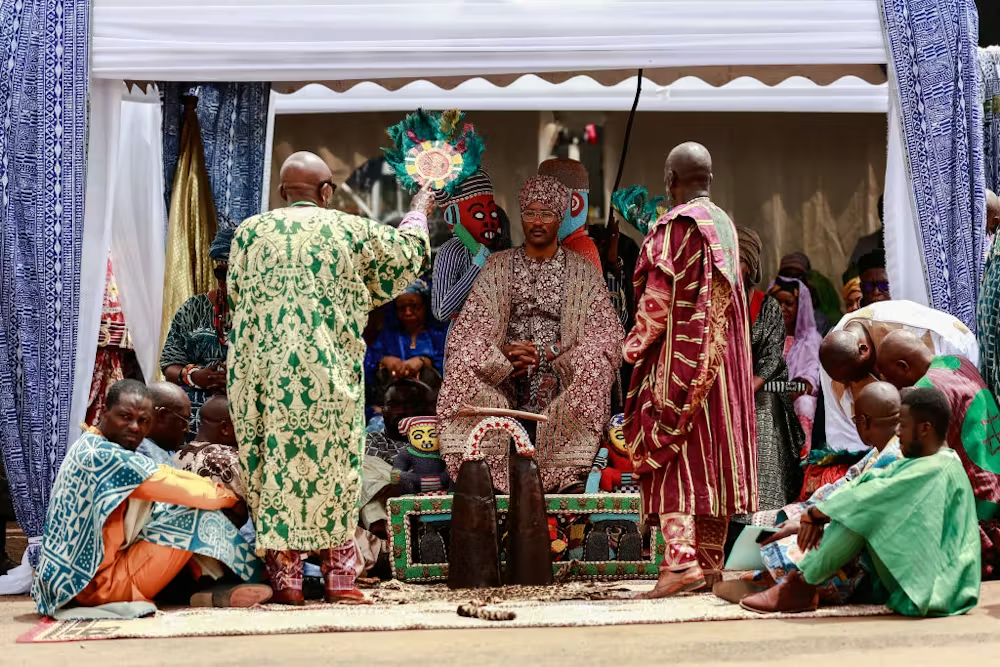
Sultan who Rejects 14-Year-Old Bride
In the age of viral clips and rapid-fire social media headlines, few stories have captured the global imagination like that of His Royal Majesty Nabil Mbombo Njoya. Since his enthronement in October 2021 as the 20th Sultan and King of the Bamum people in Cameroon, a specific narrative has transformed him into a modern folk hero: the story of a young, Western-educated monarch who publicly refused to accept a 14-year-old girl as a traditional "tribute" bride.
While the "viral" specifics of this event often blur the lines between internet legend and documented fact, the resonance of the story points to a much deeper truth. In a continent where the tug-of-war between ancient custom and modern human rights is a daily reality, Sultan Nabil represents a new breed of African royalty, one that uses the weight of a 600-year-old throne to champion the future of the girl child.
To understand the Sultan’s progressive trajectory, one must look at the man behind the bead-encrusted crown. Born into the prestigious Nchare-Yen dynasty, Nabil Mbombo Njoya was not raised solely within the palace walls of Foumban. He is a product of global excellence, having earned a degree in Networking and Telecommunications from St. John’s University in New York and a Master’s in Public Law from the University of Yaoundé II.Before ascending the throne at age 28, he served as a high-ranking civil servant—specifically as the Head of the Legal Division in Cameroon’s Ministry of Territorial Administration. This unique background means he doesn't just view tradition through the lens of nostalgia; he views it through the lens of a trained legal administrator. For Sultan Nabil, "tradition" is not a static relic of the past, but a living contract that must evolve to protect its most vulnerable citizens.
In the Bamum Kingdom, one of Central Africa’s oldest and most culturally significant monarchies, the Sultan is more than a political figure; he is the "Mfon," the spiritual and traditional father of his people. Historically, "tribute marriages" were common tools for diplomacy, where noble families offered daughters to the King to cement alliances.
In a region where child marriage is not yet totally abolished, a Sultan’s refusal to participate in such customs is a seismic shift. In Cameroon, while the legal age for marriage is technically 18, loopholes in the Civil Status Registration and various customary laws have historically allowed for marriages of girls as young as 15 with parental or judicial consent.
When a leader of Nabil’s stature chooses a partner based on mutual adulthood, as seen in his 2022 marriage to his wife, Aïcha, he sends a royal decree without ever saying a word. He signals to every father, village head, and suitor in his kingdom that the value of a girl is found in her education and her agency, not by age and “innocence”.
Sultan Nabil is not alone in this crusade. He belongs to a growing "vanguard of reformist monarchs" across Africa who are using their traditional influence to plug the gaps where national legislation falls short. He joins figures like Chief Theresa Kachindamoto of Malawi, who famously annulled over 2,500 child marriages, and various traditional rulers in Nigeria and Ghana who are increasingly vocal about the African Union’s campaign to "End Child Marriage in Africa."Traditional leaders possess a "grassroots legitimacy" that politicians often lack. While a law passed in a distant capital might be ignored in a rural village, a word from the King is law. By aligning himself with organizations like UNICEF, which honored him in 2024 for his work on birth registration and girls' education, the Sultan is bridging the gap between international human rights and local culture.
Whether or not the specific viral "14-year-old rejection" scene happened exactly as social media suggests, the fact that millions of Africans celebrated the story is telling. It reflects a collective hunger for leadership that respects the crown but protects the child. As the Bamum Kingdom moves further into the 21st century, Sultan Nabil Mbombo Njoya is proving that being a "custodian of tradition" does not mean being a captive of the past. He is demonstrating that the greatest way to honor one's ancestors is to ensure that the next generation of daughters can grow up with their dreams, and their childhoods, fully intact.
#UTVAfrica#