Nigeria Missing, Nigerians Everywhere: The World Cup Story the Super Eagles Never Got to Tell
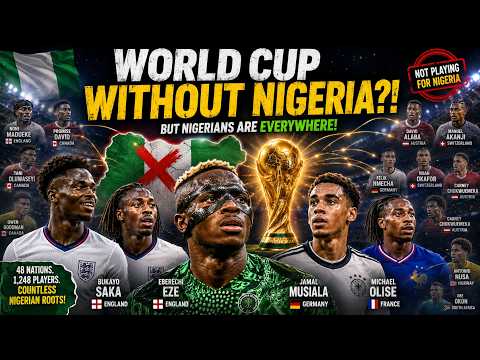
While the Super Eagles of Nigeria did not qualify for the 2026 FIFA World Cup, 16 players of Nigerian descent are representing other nations at the tournament. Here is a breakdown of the players with Nigerian heritage and the countries they are representing.
Nigeria missed out on a second consecutive FIFA World Cup after falling to DR Congo in the African playoffs, extending what has become one of the most painful periods in the country's football history. For a nation long regarded as one of Africa's football powerhouses, the absence of the Super Eagles from the global showpiece remains a bitter pill to swallow.
Yet, even in their absence, Nigeria's fingerprints are all over the tournament.
Across stadiums in the United States, Canada and Mexico, players with Nigerian roots are helping to drive the ambitions of nine different nations, underlining the extraordinary influence of Nigerian football talent on the world stage. From England's star-studded attack to Germany's midfield, from Canada's emerging generation to Switzerland's experienced defence, Nigerian heritage continues to shape the story of the 2026 FIFA World Cup.
In many ways, Nigeria may be absent in name, but its presence is impossible to ignore.
England and Canada Lead the Nigerian Connection
England is one of the teams with the strongest Nigerian connections at the World Cup, alongside Canada, with three players of Nigerian descent each.
The Three Lions arrived in North America with Bukayo Saka, Eberechi Eze and Noni Madueke in their squad.
Saka has developed into one of the world's best attacking players, combining creativity, intelligence and consistency at the highest level. Alongside him, Eze brings flair and unpredictability in midfield, while Madueke offers pace and directness from the wings.
All three were eligible to represent Nigeria through their family heritage before committing their international futures elsewhere.
Musiala Headlines Germany's Nigerian Connection
For Germany, the standout name is undoubtedly Jamal Musiala.
Widely regarded as one of the finest young footballers in the world, Musiala's dazzling dribbling and creativity have made him central to Germany's World Cup ambitions. Alongside him is midfielder Felix Nmecha, another player with Nigerian roots who continues to establish himself in the national team.
Switzerland's Nigerian Influence
Switzerland's hopes of advancing deep into the tournament are boosted by two players of Nigerian descent.
Defender Manuel Akanji remains the leader of the Swiss defence, while forward Noah Okafor provides pace, versatility and attacking quality. Both have become important figures in Switzerland's squad.
Austria's Blend of Experience and Youth
Austria's squad features one of football's most accomplished defenders, David Alaba.
The former Real Madrid defender has enjoyed an outstanding career at club and international level and remains Austria's leader both on and off the pitch. Joining him is Carney Chukwuemeka, whose Nigerian heritage adds another chapter to the country's remarkable football diaspora story.
Canada's Rising Nigerian Influence
Co-hosts Canada have three players of Nigerian descent in their World Cup squad.
Tani Oluwaseyi, Promise David and Owen Goodman reflect the growing contribution of players with Nigerian heritage to Canadian football.
Balogun Flying the Flag for the United States
The United States continues to benefit from one of the most talked-about international eligibility decisions involving Nigeria in recent years.
Striker Folarin Balogun, who was eligible to represent Nigeria before committing to the United States, has since become a key figure in the American attack. His movement and finishing make him one of the hosts' most dangerous forwards.
France's Emerging Star
Among the most exciting players at the tournament is Michael Olise, whose creativity and technical brilliance have established him as one of France's most exciting attacking players.
With Nigerian roots and elite-level talent, Olise represents yet another example of the global reach of Nigerian football heritage.
Norway and South Africa Also Represented
Norway's exciting young attacker Antonio Nusa carries Nigerian heritage and is widely regarded as one of Scandinavian football's brightest prospects.
Meanwhile, South Africa's squad includes Imé Okon, a promising defender whose Nigerian roots further highlight the global reach of Nigerian football talent.
The Full List
England
- Bukayo Saka
- Eberechi Eze
- Noni Madueke
Germany
- Jamal Musiala
- Felix Nmecha
Switzerland
- Manuel Akanji
- Noah Okafor
Austria
- David Alaba
- Carney Chukwuemeka
Canada
- Tani Oluwaseyi
- Promise David
- Owen Goodman
United States
- Folarin Balogun
France
- Michael Olise
Norway
- Antonio Nusa
South Africa
- Imé Okon
A World Cup Without Nigeria—But Not Without Nigerians
The 2026 FIFA World Cup serves as a reminder of both Nigeria's immense footballing potential and its recent struggles on the international stage.
While the Super Eagles watch from afar, their influence remains impossible to ignore. In virtually every phase of the tournament, players with Nigerian heritage are competing for football's biggest prize. Some are established stars, while others are emerging talents. Together, they showcase the extraordinary reservoir of footballing ability linked to Nigeria.
For Nigerian supporters, that reality is bittersweet.
The green-and-white flag may not be flying at the World Cup, but the sons of Nigeria certainly are. As the tournament unfolds across North America, they continue to tell a story that Nigerian football itself was unable to write—a story of talent, opportunity and a legacy that extends far beyond the borders of one nation.
By KELECHI AGUOCHA